

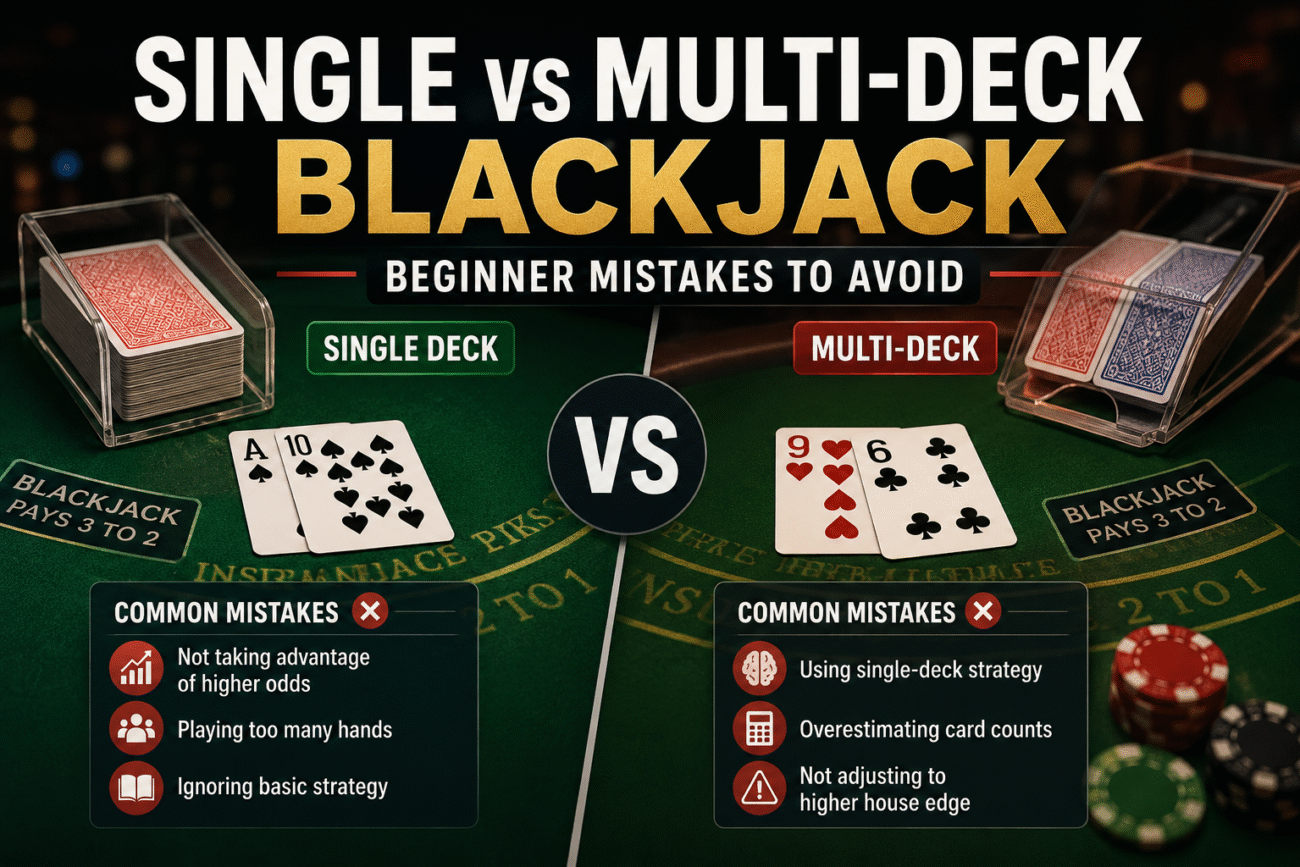
Picking a blackjack table can look simple until deck count, payout rules, and dealer actions start changing the math behind every hand. Many beginners see “single-deck” and assume it is the safest option, yet a table with fewer cards can still carry poor conditions that raise the casino’s advantage.
This guide explains how single-deck, double-deck, and multi-deck blackjack differ, why payouts matter as much as the number of cards in play, and how basic strategy shifts with table rules. It also highlights common beginner mistakes so Bangladeshi players can compare tables with a clearer, more practical checklist before betting.
Why Deck Count Matters More Than Beginners Think
Deck count is not a decorative table detail. It changes how often natural blackjack appears, how much each removed card affects the remaining shoe, and how difficult it is to track favorable or unfavorable cards. With otherwise equal rules, the house edge moves from 0.014% with one deck to 0.577% with eight decks. More decks also tend to create longer shoes and a steadier game flow, while single-deck tables make every exposed card more meaningful. That is why beginners need a strategy chart that matches both deck count and table rules.
Single-Deck vs Multi-Deck Blackjack: The Core Difference
The main difference is card concentration. Single-deck blackjack uses 52 cards, while multi-deck games usually use 2 to 8 decks, with 6-deck and 8-deck shoes common in casinos. Fewer decks make each dealt card more important because it changes the remaining card mix faster. With more decks, that effect is diluted, so short-term swings are less tied to one exposed card.
| Decks | Availability | House Edge Tendency | Counting Difficulty | Beginner Suitability |
| 1 deck | Less common | Lowest with fair rules | Easier | Good only with 3:2 |
| 2 decks | Moderate | Usually low | Moderate | Often balanced |
| 6 decks | Common | Higher | Harder | Good with fair rules |
| 8 decks | Very common | Highest | Hardest | Stable but rule-dependent |
Assuming Single-Deck Tables Are Always Better
The “one deck is always better” idea is one of the easiest traps for new blackjack players. With equal rules, single-deck blackjack usually gives Bangladeshi players a stronger mathematical position because each card has more impact on the remaining deck. Casinos often offset that advantage with less favorable terms. A single-deck table may pay 6:5 instead of 3:2, restrict doubling-down options, prohibit doubling after a split, or require higher minimum bets. Once those rules are added, the lower deck count can lose much of its value. A fair multi-deck table can be the smarter pick.
Ignoring Blackjack Payouts — 3:2 vs 6:5
Blackjack payout is one of the most expensive details to overlook. A 3:2 table pays 150 BDT on a 100 BDT blackjack, while a 6:5 table pays only 120 BDT for the same hand. That 30 BDT gap sounds small, but it applies to the best starting hand in the game and adds up across many sessions. A single-deck table with 6:5 payouts can easily be weaker than a 6-deck or 8-deck table that still pays 3:2. Beginners should check the payout line before sitting down, because this rule can outweigh the benefit of fewer decks.
Using the Same Basic Strategy at Every Table
Basic strategy is not one universal chart for every blackjack table. It changes with the player’s hand, the dealer’s upcard, and the rules attached to that table. Deck count matters, but so do whether the dealer hits or stands on soft 17, surrender, doubling after splitting, and double-down limits. The decision order also matters: check surrender first when available, then splits, doubles, and finally hit or stand. A Bangladeshi player using a single-deck chart at an 8-deck H17 table may make avoidable mistakes. Beginners should match their chart to the exact rules before they treat any decision as automatic.
Best Casino for Playing Blackjack: MelBet
MelBet is a strong option for Bangladeshi players who want more than a basic blackjack table. Its casino section includes live dealer blackjack, mobile-friendly access, and a broad game lobby, which makes it convenient for shorter sessions as well as longer play. New customers from Bangladesh can also find a 150% welcome offer of up to 100,000 BDT on their first deposit.
For blackjack players, the main appeal is the mix of live tables, quick account access, and regular promo opportunities. The best approach is still to compare table rules first, especially blackjack payout, dealer soft 17 rules, and double down options before choosing where to sit.
After registration, players can use the MelBet login BD option to access their account, activate available bonuses, and move straight to the blackjack lobby.
How Deck Count Changes Probabilities and Player Decisions
Deck count changes more than the chance of seeing a natural blackjack. In a single-deck game, the probability of being dealt a natural blackjack is about 4.83%, compared with about 4.75% in an 8-deck game. That difference looks small, yet it affects the long-term value of strong starting hands. Deck count also changes how players should read stiff hands like 12 through 16. When fewer cards remain, each low or high card already dealt has a stronger effect on bust probability.
This makes correct hit or stand decisions more sensitive to the exact table setup. In multi-deck games, the same decisions are usually more stable, but the basic strategy chart still needs to match the rules.
Overvaluing Card Counting as a Beginner
Single-deck blackjack can make card counting easier because each exposed card changes the remaining deck more sharply. That does not mean beginners should build their table choice around counting. Trying to track cards too early often distracts from the bigger job: playing basic strategy correctly on every hand. Multi-deck games are harder to count because the larger shoe reduces the impact of one card, but casual players gain more by avoiding simple strategic errors first. A Bangladeshi player who misplays splits, doubles, or stiff totals will lose far more value than deck count alone can recover.
Choosing the Table by Deck Count Only, Not by Full Ruleset
Deck count should be checked, but it should never be the only filter. A beginner comparing blackjack tables should also review whether blackjack pays 3:2 or 6:5, whether the dealer hits or stands on soft 17, and which double down options are allowed. Other important details include double after split, surrender, resplitting aces, table minimums, and the shuffling method. House edge is calculated from the full ruleset, not from deck count in isolation. A one-deck game with harsh limits can be less player-friendly than a six-deck table with fair payout and flexible doubling rules.
Best Table Choice for Beginners: Single-Deck, Double-Deck, or Multi-Deck?
For beginners, the safest choice is usually the table that is easiest to play correctly. A double-deck or 6-deck game can be a strong starting point when the rules are clear, the pace is comfortable, and the player has the right basic strategy chart. Single-deck tables are worth considering only when the payout and playing options do not remove their mathematical appeal.
New players should also avoid crowded rule sets with distracting side bets, unusual limits, or rushed dealing speed. The goal is not to find the rarest format, but to choose a table where good decisions are easier to repeat hand after hand.
Beginner Checklist Before Sitting Down at a Blackjack Table
Before Bangladeshi beginners place the first bet, they should make a quick rules check instead of judging the table by its deck label. These questions help separate a fair game from one that only looks attractive at first glance:
- How many decks are used?
- Does blackjack pay 3:2 or 6:5?
- Does the dealer hit or stand on soft 17?
- Can the player double after splitting?
- Is surrender available?
- Are aces allowed to be resplit?
- Do the table minimums fit the bankroll?
- Is the game hand-shuffled, shoe-dealt, or continuously shuffled?
- Does the player’s basic strategy chart match this exact table?
- Has the casino reduced the value of single-deck play with stricter rules?
A table that passes most of these checks gives beginners a better base for consistent decisions.
FAQ
Is single-deck blackjack always better than multi-deck blackjack?
No. With equal rules, single-deck blackjack often gives players a better mathematical position. The problem is that many single-deck tables use weaker conditions, especially 6:5 payouts. A multi-deck table with 3:2 payouts can offer better value.
How many decks are best for Bangladeshi beginner blackjack players?
Beginners should look beyond deck count and judge the full ruleset. A clear 2-deck or 6-deck table with 3:2 payouts, fair double rules, and a matching basic strategy chart is often easier to play well than a restrictive single-deck game.
Does basic strategy change with the number of decks?
Yes. Deck count can change some basic strategy decisions, although many differences are small. Rules such as H17 or S17, surrender, and double after split can have a stronger impact. The chart should match the exact table setup.
What is the biggest beginner mistake when choosing a blackjack table?
The biggest mistake is choosing a table just because it says single-deck. Beginners should also check 3:2 versus 6:5 payouts, H17 or S17, double and split rules, surrender, table limits, and the correct basic strategy chart.
Is card counting easier in single-deck blackjack?
Yes. Card counting is easier in single-deck blackjack because each card changes the remaining deck more noticeably. Still, beginners gain more from learning basic strategy first. Counting without strong fundamentals often creates extra mistakes instead of improving long-term results.
