

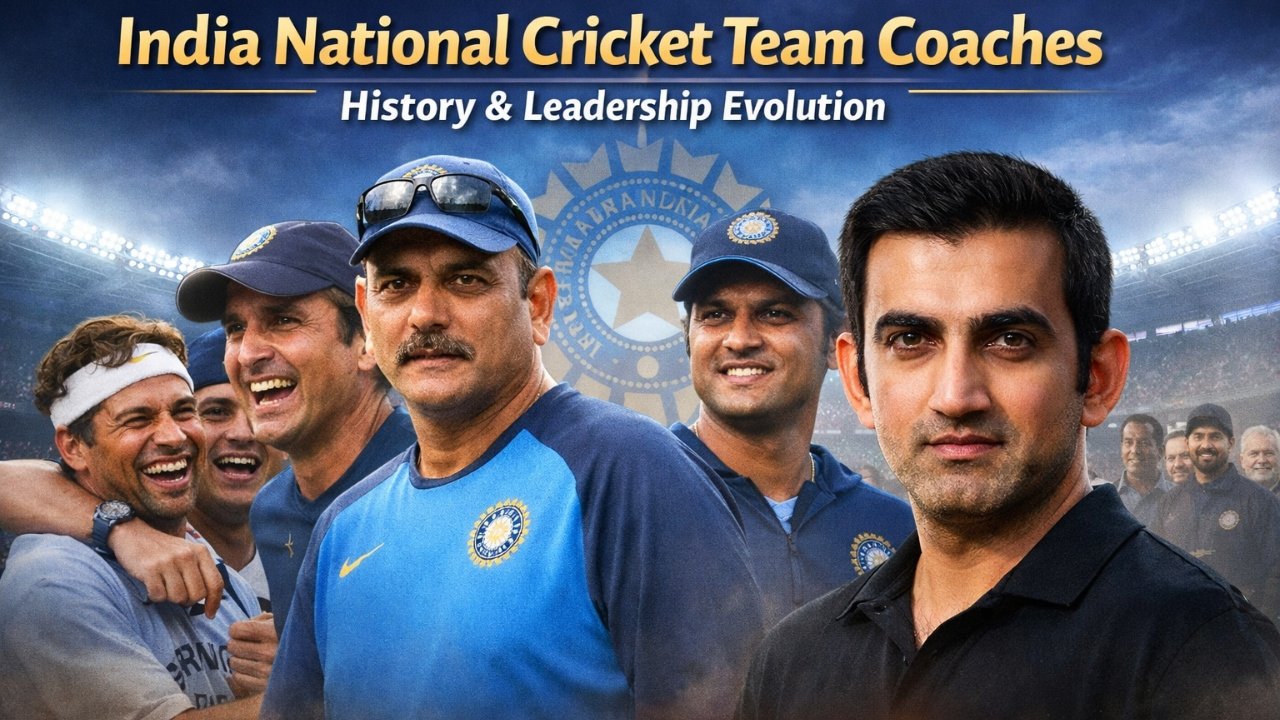
The Indian cricket team is one of the world’s dominant cricket teams. Indian cricket, which in the past had produced legends and historical victories while also bagging fanatical following, has emerged as a world super power over the years. In the glare of the public eye, captains and players get due recognition, but equally important is the role played by coaches in crafting teams.
Coaching is an essential element that guides the development of player abilities, match strategies, fitness levels, and team spirit. Indian cricket coaching has evolved similar to the sport in general, changing from a pastime to a well-managed, professional, scientific discipline. India’s progress in the international circuit was nurtured by a number of eminent coaches over the years, all of whom had different coaching philosophies, leadership styles and technical inputs.
What do you think the Coaches will be able to bring into International Cricket?
Coaches teach the skills players need to succeed at their sport, devise game strategies, discipline players and oversee athletes’ performance. Cricket now is not all about talent, it’s also about sports science and fitness management, psychological support and performance analysis.
Key Responsibilities of Team Coaches
- Designing training programs
- Improving technical skills of players
- Planning match strategies
- Enhancing team psyche and inner strength
- Working with selectors and management
- Monitoring player fitness and performance
- Analyzing opposition teams
Coaches are the teachers and tacticians who lead the players on and off the field.
Pre coaching Period of Indian Cricket
Until the 20th-century professional coaching wherein support staffs and roles such as psychologist, performance analysts, physios (otherwise known as profession who help to recover from injury) and nutritionists within the CWC teams were never taken into account before late 20th century. The older players and the captains, were the ones who had to carry these young fellows. As competitive international cricket developed, the demand for specialist coaches grew.
India began to formally appoint head coaches in the late 1990s. Since then, the Indian team has been coached by legends of the game and international professionals.
Prominent Coaches of the India National Cricket Team and Their Achievements
Building the Foundation Keki Tarapore
Keki Tarapore was one of the first well-known coaches in Indian cricket, from the 1970s. In an era when coaching infrastructure was still relatively new, Tarapore mainly concentrated on building up the technical skills of the players and inculcating disciplined training.
His coaching revolved around developing a high level of skill in basic cricketing attributes such as footwork, shot selection and accuracy with the ball. Tarapore was associated with the domestic cricketers and helped set early coaching standards to mold future training modules. He did not lead India to a major international tournament win during his tenure, but his contribution played an important role in moulding India’s initial coaching set-up and professional approach for a coach in terms of shaping players’ careers.
Bishan Singh Bedi – Discipline and the Art of Bowling
The great Indian spin bowler, Bishan Singh Bedi, was coach in the early nineties. Strong willed and a disciplinarian, Bedi had laid great emphasis on the improvement of bowling standards and played attacking cricket.
Under his tutelage, the bowlers were taught to be accurate, persistent and mentally tough during long spells. To Bedi, strong bowling attacks could win matches on any surface. His propelling emphasis on his players being super fit and as committed to their profession made the Indian cricket team move slowly into an competitive international outfit.
Ajit Wadekar – Taking Team Confidence to Next Level
The former Indian skipper and a revered cricket tactician, Ajit Wadekar, was made the head coach in the early 90s. His captaincy coincided with a period of change in Indian cricket, which was looking to fashion an international image.
Wadekar worked a lot on building up the confidence of the team and improving their batting, right from the top-order to tail. His coaching ethos was based on mental preparation and whiteboard strategy, and India became competitive at home. One of his most successful stints was leading the team to the semi-finals in 1996 Cricket World Cup, a campaign that lifted the spirits and heightened expectations from fans.
Wadekar had a style of leadership that made him stand out from the other Indian captains. He always emphasised on camaraderie and honesty in relationships and his emphasis helped India at a time when their administration was known for internal squabbling and backbiting.
The development of young players with Anshuman Gaekwad
Guwahati: Former India coach Anshuman Gaekwad played a key role in identifying fresh cricket talent during his multiple stints as the national team’s head man. During his reign, he witnessed the rise of future stars like Rahul Dravid and Sourav Ganguly.
Gaekwad stressed a lot on enhancing fitness levels of the players and creating a balanced side. He told players to adjust in a game and focus on consistency. During his stint as the coach of India, he laid the foundation for a robust nucleus of players which later on flourished into match-winners in all formats.
Gaekwad was a calm and nurturing coach who gave young cricketers the confidence to battle international cricket.
Kapil Dev – Promoting Cricket And Not Fear.
It was a time when Indian crickets needed the services of Kapil Dev, the country’s first World Cup-winning captain, as its head coach. A cricketer known for his aggressive play and leading ability, Kapil inspired players to play bold and attacking cricket.
His coaching policy was on the creation of strong all-rounders who could bat and bowl. Kapil thought that attacking game play and self-expression were the way to take on powerful international teams. His coaching stint was rocked by scandal and was cut short, but his inspirational leadership made for a player mentality and team camaraderie that lasted.
John Wright - the man who built modern Indian Cricket
John Wright was appointed as the head coach of India and is considered one of the most successful coaches in Indian cricket history. His appointment was significant as India then began to follow modern coaching and organized training.
Wright and India’s then captain Sourav Ganguly worked closely to trying to develop an aggressive, competitive Indian team. He concentrated on overseas performance, a vulnerable spot for India in earlier times. India made it to the final of 2003 ICC Cricket World Cup under Ganguly’s captaincy and he cultivated match-winners in Virender Sehwag, Harbhajan Singh and Yuvraj Singh.
Wright’s quiet leadership, strategic scheming and positive-player relationships led to the establishment of a consolidated side on the test match circuit that was as respected internationally.
Gary Kirsten- Coach who Won World Cup
Like we earlier mentioned, Gary Kirsten is widely regarded as Indian cricket’s most successful coach. Under his leadership from 2008 to 2011, India realised unprecedented success in international cricket.
Kirsten also forged close relationships with players and made a point of promoting a good team environment. He stressed mental toughness, self-belief and teamwork. India and also attained Test ranking to the No.1 position under his coaching 2011 The historic year when India won ICC 3 world Cup and became countries first No.1 test tag On Feb, 2008,Gary Kirsten was appointed as a coach of Indian national team for two years term which got Dravid’s supportAlthough he said he won’t be training longterm yet gives benefit both for him & SG but Anil Kumble too got benefited by having Gary as a coach so is Sachin in near future But then..!?
He was also good in man-management and handling of big players, resulting in one of the most harmonious and successful phases in Indian cricket.
Duncan Fletcher – The Emphasis on the Long Term
Kirsten was replaced by Duncan Fletcher, who brought in analytics and long-term building as part of his system. His special focus in coaching has been with respect to performance data, player work load management and refining the skills.
There was also an element of transition as old players had retired and new blood had to be introduced, a period Fletcher worked through. He was a huge influence in bringing new boys into the side and shaping them for future cricket as well. His focus on technical development and analysis assisted India to remain competitive in a period when the team was being re-constructed.
Anil Kumble – Discipline, And Bowling
Discipline, professionalism and strategic clarity were brought by one of India’s greatest bowlers, Anil Kumble during his time in charge. He concentrated on the development of bowling tactics and team fitness.
India’s spin rejoinderUnder Kumble’s guiding force, India were lords of Test cricket and kept finding resolute seam-bowling performances across conditions. His demanding but respectful approach got the attention not only of his players, but of management.
Ravi Shastri – Creation of Fearless and Positive Cricket
Ravi Shastri was instrumental in turning India into an aggressive and confident cricketing unit. During his coaching reign, the team laid emphasis on aggressive cricket and the ability to play quick bowling well and beating strong teams overseas.
Shastri has guided India to historic Test series wins in Australia. He’d also worked hard to establish a winning culture in the locker room and make sure his players knew they could compete with anyone when they brought energy to the rink.
Shastri’s man management and good communication skills ensured that India continued to dominate in all formats of the game.
Rahul Dravid – Organised Growth and Youth Centricity.profile.
Rahul Dravid gave a sense of stability, structure and futuristic planning to Indian cricket coaching. Playing with and coaching the country’s Under-19 and A teams, Dravid had worked tirelessly on shaping cricketing talent for the future.
He coaches to create bench depth, protect player minutes and establish a disciplined team culture. What Dravid preaches is the pursuit of excellence all the time, quiet leadership and performance that enables India to make a mark in world cricket.
Changing Role of the Coach in Indian Cricket
Cricket coaching in India has transitioned from ‘one-coach-fits-all’ to support staff for everything. Today’s coaching staff includes batting and bowling coaches, fielding specialists, strength and conditioning trainers and sports psychologists.
This all-encompassing support structure aids develop players into specialists in every facet of the game. Contemporary coaching in addition takes advantage of cutting edge technology, use of video replay, and even statistical analysis to enhance match tactics as well as player readiness.
Impact of Coaches on India’s Cricket Success
India’s success in cricket has been much about bold coaching leadership.
Performance Improvements
- Better overseas performance
- Strong fitness standards
- Balanced team combinations
Player Development
Among the legendary and star players,Coaches have had significant part on skill development of:
- Sachin Tendulkar
- Virat Kohli
- MS Dhoni
- Rohit Sharma
- Jasprit Bumrah
- Strategic Growth
Today’s coaches are ensuring India make advanced use of match strategies and data-based decisions.
Conclusion
History of Indian cricket has been a journey of India National Cricket team coaches. From early coaches to present day professionals, every coach has played a part in creating this fine and successful cricket team. It’s their vision, strategic planning and development of players that has given India so many outstanding cricketers on the international stage.
As long as cricket keeps on changing, coaching will still be the backbone of India’s thriving. With better use of technology, sports science and structured development programmes the future coaches will be an even more important in creating the next generation of Indian cricketing heros.
Also Read:
