

Numbers have always played an immense role in the game, and of all the stats to judge a batsman by, strike rate is one of its most influential ones. Where that trade-off occurs can vary by format – whether T20, one-day internationals or even the longest form of the game; Tests – but ultimately a batsman’s strike rate is about how effectively and quickly he accumulates runs. With the game being faster and more dynamic nowadays, knowing about strike rate, and using a strike rate calculator has become indispensable for-players, coaches and analysts as well as casual supporters.
In this comprehensive explainer we will delve into what strike rate is, how you can calculate it manually, why it matters and a table of top players with highest strike rates in various formats. This article also describes how you can use a strike rate calculator to do the calculations for anyone who is interested in calculating batting analysis in a straightforward way.
What Is Strike Rate in Cricket?
The strike rate in cricket measures the rate at which a batsman scores runs. It tells you how many runs a player scores per 100 balls faced.
Strike Rate Formula:
Strike Rate = (Total Runs Scored ÷ Total Balls Faced) × 100
Example Calculation
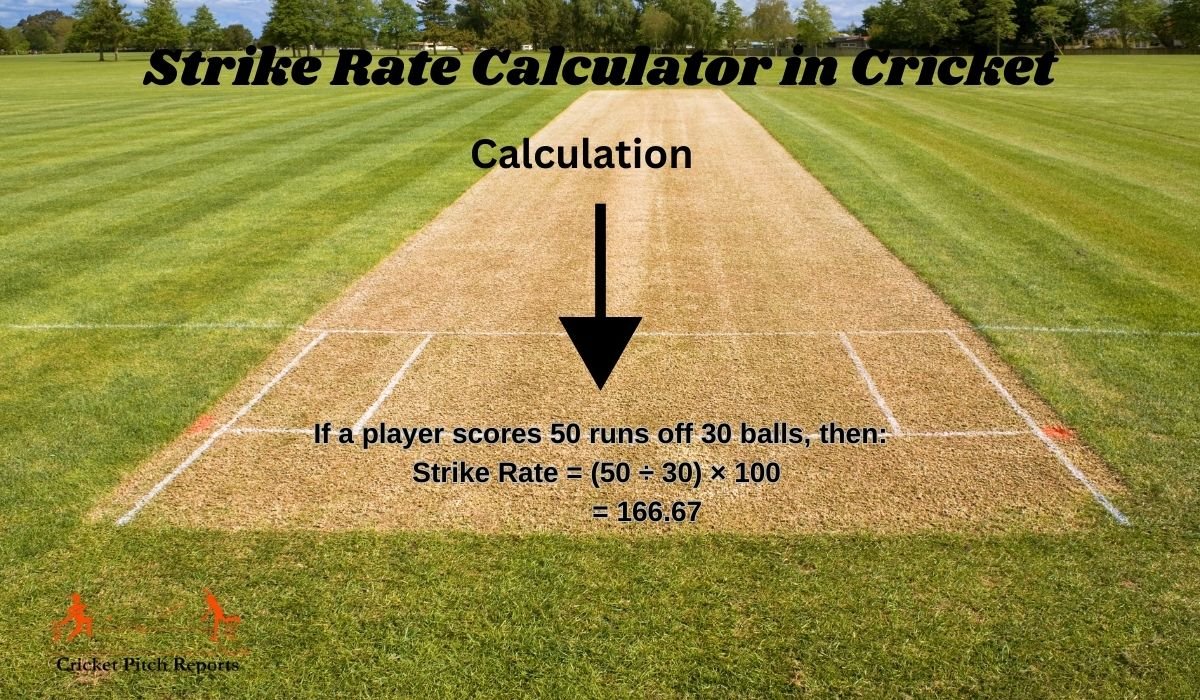
If a player scores 50 runs off 30 balls, then:
Strike Rate = (50 ÷ 30) × 100
= 166.67
Why Is Strike Rate Important?
Strike rate is an essential post-modern-era statistical measure because it indicates a batsman’s ability:
- Score quickly
- Maintain pressure on bowlers
- Rotate the strike
- Accelerate in crucial overs
- Ball-by-ball: Anchor or construct an innings sensibly
Format-Wise Impact
- T20 Cricket: SR is everything. Use player with over 140 is elite.
- ODI Cricket : You need to combine strike rate with consistency.
- Test Cricket: This is not a primary yardstick but high strike rates from players frequently alters the tempo of a game.
Contrary to the batting average (which is more a measurement of consistency), the strike rate targets your scoring speed and this becomes hugely significant in today’s attack-minded playing surroundings.
How to Calculate Strike Rate Manually
To calculate a player’s strike rate manually, follow these steps:
- Find Total Runs – Add all runs scored by the batsman.
- Count Balls Faced – Include legal deliveries only.
- Apply the Formula:
Strike Rate = (Runs ÷ Balls Faced) × 100
Example
A batsman scores 75 runs off 50 balls:
Strike Rate = (75 ÷ 50) × 100
= 150
What Is a Strike Rate Calculator?
A strike rate calculator is a method of calculating a batsman’s strike rate through the use an online or mobile software application. Users simply enter:
- Total Runs
- Balls Faced
and the calculator immediately displays what certain betting at that strike rate will do.
Advantages of Utilizing a Strike Rate Calculator
- Fast and error-free
- Helpful for match analysis
- For use by players, coaches, scorers and fans
- Useful for fantasy cricket selections
- Perfect for post-game analysis and team talks
Whether you are watching professional games or local backyard cricket game, the strike rate is one of the simplest tools in cricket to analyse your game play.
Highest Strike Rates in International Cricket
Highest Strike Rates in ODI Cricket
| Player | Matches | Innings | Runs | Balls Faced | Strike Rate |
| Andre Russell (WI) | 56 | 47 | 1034 | 794 | 130.22 |
| Glenn Maxwell (AUS) | 149 | 136 | 3990 | 3149 | 126.7 |
| Lionel Cann (BER) | 26 | 25 | 590 | 504 | 117.06 |
| Heinrich Klaasen (SA) | 60 | 56 | 2141 | 1829 | 117.05 |
| Shahid Afridi (PAK) | 398 | 369 | 8064 | 6892 | 117 |
| Jos Buttler (ENG) | 190 | 163 | 5274 | 4565 | 115.53 |
| Michael Bracewell (NZ) | 34 | 29 | 757 | 656 | 115.39 |
| Phil Salt (ENG) | 33 | 31 | 988 | 861 | 114.75 |
| Luke Ronchi (AUS/NZ) | 85 | 68 | 1397 | 1220 | 114.5 |
| Yusuf Pathan (IND) | 57 | 41 | 810 | 713 | 113.6 |
Highest Strike Rates in Test Cricket
| Player | Matches | Innings | Runs | Strike Rate |
| Harry Brook* | 26 | 41 | 2339 | 88.9 |
| Shahid Afridi | 27 | 48 | 1716 | 86.97 |
| Ben Duckett* | 34 | 61 | 2410 | 86.78 |
| Tim Southee | 107 | 156 | 2245 | 82.69 |
| Virender Sehwag | 104 | 180 | 8586 | 82.21 |
| Adam Gilchrist | 96 | 137 | 5570 | 81.96 |
| Colin de Grandhomme | 29 | 44 | 1432 | 80.45 |
| Graeme Swann | 60 | 76 | 1370 | 76.49 |
| Rishabh Pant* | 44 | 76 | 3013 | 73.38 |
| Kusal Perera | 22 | 41 | 1177 | 72.25 |
Highest Strike Rates in T20 Internationals
| Player | Matches | Innings | Runs | Balls Faced | Strike Rate |
| Abhishek Sharma (IND) | 17 | 16 | 535 | 276 | 193.84 |
| KJ Stagno (GIBR) | 25 | 24 | 656 | 370 | 177.29 |
| Faisal Khan (KSA) | 56 | 56 | 1597 | 923 | 173.02 |
| OJ Hairs (SCOT) | 27 | 27 | 438 | 257 | 170.42 |
| Taranjeet Singh (ROM) | 32 | 32 | 1087 | 649 | 167.48 |
| Suryakumar Yadav (IND) | 83 | 79 | 2598 | 1555 | 167.07 |
| Saber Zakhil (BEL) | 48 | 43 | 991 | 596 | 166.27 |
| Phil Salt (ENG) | 43 | 40 | 1193 | 726 | 164.32 |
| Yashasvi Jaiswal (IND) | 23 | 22 | 723 | 440 | 164.31 |
| HS Gericke (MLT) | 21 | 20 | 541 | 330 | 163.93 |
Highest Strike Rates in IPL History
| Player | Matches | Innings | Runs | Balls Faced | Strike Rate |
| Phil Salt | 34 | 34 | 1056 | 601 | 175.7 |
| Andre Russell | 140 | 115 | 2651 | 1522 | 174.17 |
| Travis Head | 38 | 37 | 1146 | 674 | 170.02 |
| Heinrich Klaasen | 49 | 45 | 1480 | 872 | 169.72 |
| Nicholas Pooran | 90 | 87 | 2293 | 1357 | 168.97 |
| Sunil Narine | 189 | 122 | 1780 | 1069 | 166.51 |
| Abhishek Sharma | 77 | 74 | 1816 | 1114 | 163.01 |
| Liam Livingstone | 49 | 47 | 1051 | 662 | 158.76 |
| JM Sharma | 55 | 47 | 991 | 631 | 157.05 |
| Virender Sehwag | 104 | 104 | 2728 | 1755 | 155.44 |
Case Study: Strike Rate in the 2016 T20 World Cup Final
One of the greatest examples of the strike rate effect is Carlos Brathwaite’s match-winning World Cup final in 2016. Batting at well over 200, he clobbered four straight sixes in the last over that killed the match in West Indies’ favour.
This match also illustrated exactly what a high strike rate can do to change momentum in the blink of an eye and shape championships.
Strike Rate Calculator – Why You Should Use It
A Lean, Mean Striking Machine You’re a player trying to get better, you’re a coach watching your team or you are interested in metrics The strike rate calculator helps you:
- Compare batting speeds quickly
- Identify aggressive vs. defensive players
- Quantify performance between games and formats
- Appreciate effect in power plays or death overs
- Improve strategy and decision-making
Given that T20 cricket is an ever-evolving format, the strike rate has become as significant as average runs scored– on some occasions more.
Conclusion
The strike rate remains one of the most potent tools in understanding a batsman’s scoring efficiency. With intensive formats such as T20 cricket requiring aggressive style of play, it is the strike rate which determines a player’s worth and impact on the results. A strike rate calculator will help you to put these calculations in place, getting them right and opening up the analysis for all, regardless of whether or not you are a professional analyst.
If you’re eager to know more about how you or one of your favorite players have been performing in cricket, relying on a strike rate calculator is sure to provide a bit more depth and understanding. Get one today and advance your analysis of cricket!
Also read:
